“Our Man in Vietnam” Exhibit Opens a Window to History
Published on February 16, 2026
By Andrew Branca, UTA Marketing Coordinator
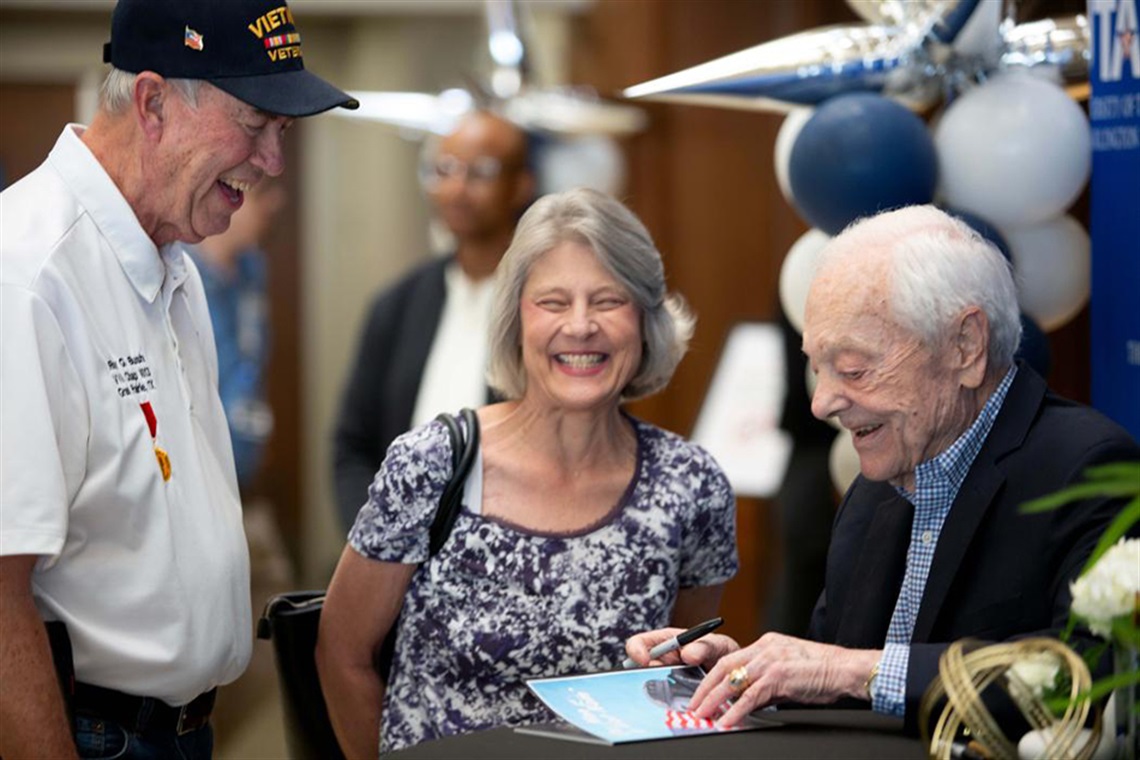
Our Man in Vietnam, a new exhibit in UTA Libraries' Special Collections, opened Feb. 9, 2026 with a powerful sense of remembrance, reflection and connection. Through photographs, paintings and personal stories, the exhibit brings history into sharp focus.
The exhibit features photographs taken by award-winning journalist Bob Schieffer during his time as a war correspondent in Vietnam, alongside painted portraits of Texas service members created from those images. Together, the works tell stories of service, sacrifice, and the individuals who lived through one of the most complex chapters in American history.
"This is just a wonderful time for me," Schieffer said during the grand opening. Reflecting on his career, he shared a guiding principle that shaped both his journalism and this exhibit: "It is not about you. It is about them, the people you are reporting on."
That philosophy resonated strongly with UTA Libraries Dean John Wang, who emphasized how naturally the exhibit fits within the university's identity.
"This university has a deep and enduring commitment to service," Wang said. "Our roots include the Carlisle Military Academy; we continue to support strong military science programs today, and we are consistently recognized as a top university for veterans."
How the exhibit came to life
University Archivist Sara Pezzoni, curator of “Our Man in Vietnam,” explained that the exhibit began with an unexpected email from Schieffer.
"Last March I received an email from Bob one afternoon, to my complete shock," Pezzoni said. "He asked if Special Collections had the negatives he had taken in Vietnam while he was a war correspondent for the Star-Telegram."
While UTA Libraries houses the newspaper's full photographic archive, those particular images weren't part of the collection yet. After several conversations, Pezzoni learned Schieffer had kept dozens of negatives, letters, and notebooks from his time in Vietnam. A visit to Schieffer's home in Washington, D.C., soon followed, resulting in a significant donation of materials to UTA Libraries' Special Collections.
"As an archivist, I needed to learn more about these important pieces of history," Pezzoni said. "From there, Bob proposed an exhibit of his photographs."
Sent by the Fort Worth Star-Telegram in 1965, Schieffer was tasked with something simple but profound: talk to the readers' children. Before he left, the newspaper encouraged families to write to him, hoping he might locate their loved ones overseas. Schieffer ultimately connected with 235 Texas soldiers, interviewing dozens and documenting their experience with the war through photographs and columns written for the Star-Telegram.
"I remember kids who would break into sobbing tears when I said, 'Your mother asked me to find out how you're doing,'" Schieffer recalled. "They were lonesome, in a place most of them had never heard of. Just a word from home helped them through a dark and very difficult situation."
Dean Wang noted that this human-centered reporting is what gives the exhibit its lasting power.
"For younger generations, the Vietnam War is often known only through films, textbooks or novels," he said. "This exhibit does something different. It brings firsthand perspectives, lived experiences, personal stories and human moments."
Faces, families and long-overdue recognition
As visitors moved through Special Collections on opening night, they encountered faces of young soldiers, moments of daily life in wartime and scenes shaped by uncertainty, courage and resilience. The space invited quiet reflection, conversation and remembrance.
James Clerihew, whose father Walter is featured in the exhibit, described the experience as deeply emotional. "He would probably cry because he would like it so much," Clerihew said. "This exhibit is about people, and that's what makes it great."
Vietnam veteran Joe Beaver Jr., a Marine sniper whose photo appears in the exhibit, recalled meeting Schieffer under extraordinary circumstances.
"We pretty much spent the night in a foxhole together," Beaver said. "He interviewed me and took some pictures. I didn't even know it was happening until he showed up on the hill where I was located."
For Beaver, the exhibit is both an honor and a reminder. "I don't think it should be about me; it should be about Bob," he said. "He did an outstanding job going to Vietnam and sending this material back."
The materials included in the exhibit are original negatives, print photographs, letters from families, notebooks from Vietnam, and painted portraits created decades later.
Pezzoni noted that Schieffer's generosity shaped the exhibit in unexpected ways.
"He also asked if it might be possible to locate the families of the soldiers he photographed and paint their portraits as a gift," Pezzoni said. "That generosity speaks volumes about who Bob is."
Preserving stories for future generations
For families of the soldiers photographed, the exhibit represents recognition that was often missing when their loved ones returned home. Evelyn Bean, whose husband, Edward Frank Bean, is featured, shared how meaningful the exhibit is to her family.
"They didn't get much recognition when they came back from Vietnam," Bean said. "I think this would have been something he really liked."
Dean Wang emphasized that exhibits like “Our Man in Vietnam” reflect the Libraries' broader responsibility.
"This is not about dogma," Wang said. "It is about humanity. History is not abstract; it is made up of real people, real choices and real sacrifices."
<div paragraph--type--bp-image="" paragraph--view-mode--default="" paragraph--id--20024="" max-w-980="" mx-auto=""> <div field--name-field-image-caption="" field--type-text="" field--label-hidden="">
Pezzoni echoed that sentiment, noting that accuracy and care guided every curatorial decision.
"The overarching theme has revolved around Bob's steadfast devotion to ensuring that we collectively provide an accurate history for future generations," she said.
Schieffer has said the deeper purpose of the exhibit is to pass along what matters most.
"The most valuable gift we can give to the next generation is an accurate history," he said. "To understand our future, we must learn from our past."
That belief closely aligns with UTA Libraries' mission. By preserving these materials and making them accessible, the Libraries create space for learning, dialogue and remembrance. Our Man in Vietnam honors Bob Schieffer's work as a journalist and artist while centering the veterans who served, those who returned home carrying unseen wounds, and those who never returned at all.
The exhibit is on view in Special Collections through April 4, 2026. The community is invited to visit, reflect, and engage with this pivotal moment in history and with the people who lived it.
For more information about the exhibit, visit the Libraries’ website at https://libraries.uta.edu/schieffer.